
By Taylor Phillips, CCL Student Staff
The availability of reliable transportation can determine a person’s access to economic opportunities, better schooling, grocery stores, and other essential aspects of daily life. While many of us have experienced firsthand how the disrepair of roads affects our ability to travel efficiently, LINK Houston, a nonprofit that advocates for a robust and equitable transportation network, decided to focus on another, often overlooked area of transportation: sidewalks.
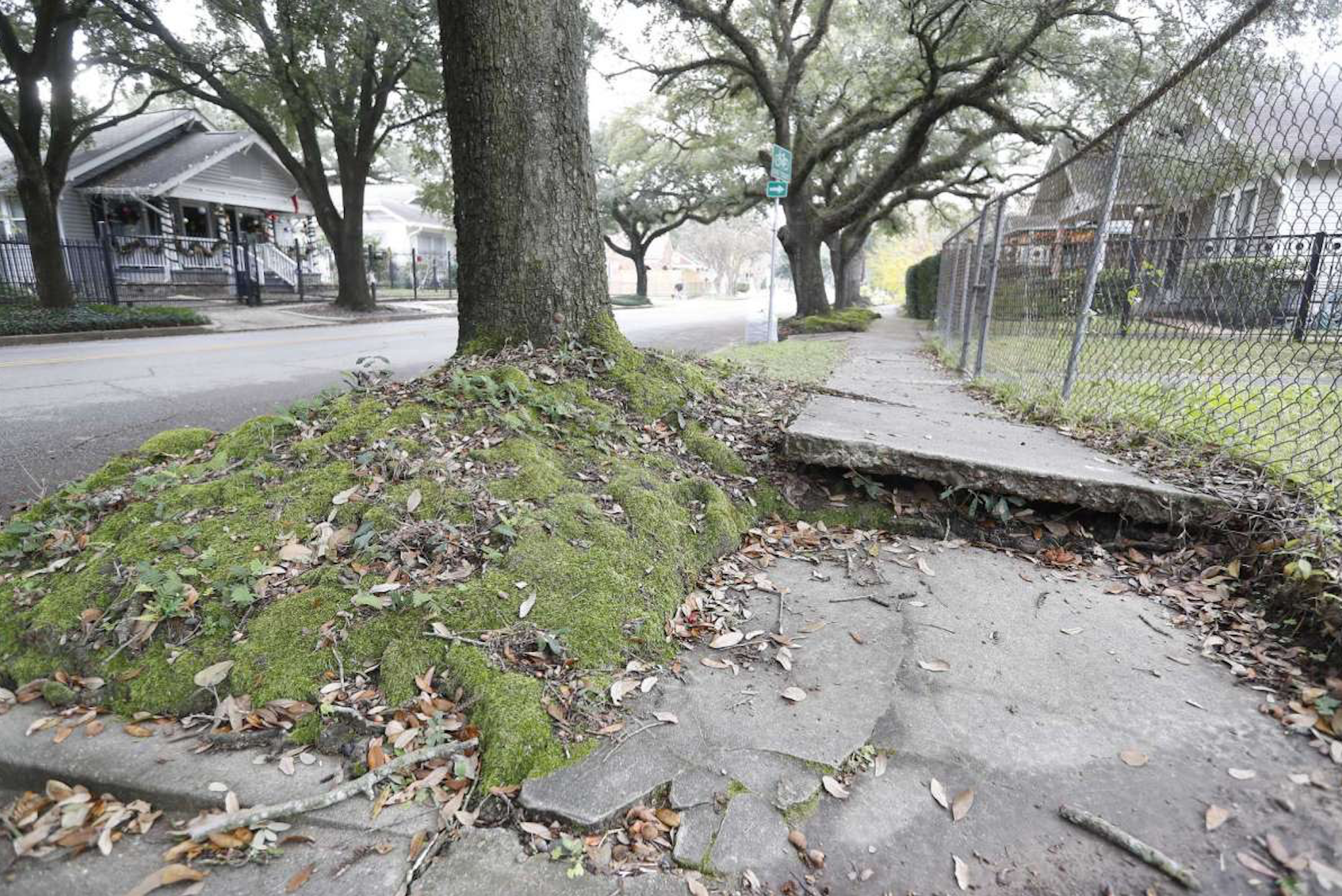
Imagine you’re a homeowner in one of Houston’s older neighborhoods. The sidewalks outside your house and around your neighborhood are likely to be cracked, crumbled, or lifted up as a result of overgrown tree roots. As well as being unsightly, damaged sidewalk pavements can pose serious accessibility issues for those in wheelchairs or using strollers and could cause harm from tripping. You decide that it would be best to have the pavement repaired. Whom do you call? Who is actually responsible for sidewalks? Is it the city?
“Short answer, no. Long answer, sometimes,” said Alan Steinberg, former Director of HART.
In Spring 2020, four students (Mitra Mirpour ‘20, Anumita Jain ‘22, Helen Bonnyman ‘20, and Lillian Didcock ‘22) were part of a CCL Houston Action Research Team (HART) that worked with LINK Houston to tackle these questions about Houston’s sidewalks. Although the task seemed simple, they found it was much more complicated.
As Jonathan Brooks, Director of Policy at LINK Houston, explained:
“Technically, the property owner is responsible for the sidewalk on the property but that’s not always the case in other cities. So, we thought most importantly it would come down to the money. What could be learned from publicly available information about how the city is using resources when they are improving sidewalks and improving streets. The team started at Houston Public Works [to talk to people that] would focus purely on sidewalks, and to the extent possible, use data. They would also reach out to different levels of government to understand how this all occurs.”
Even though the team members come from vastly different fields of study (Jain and Bonnyman from sociology, Didcock from bioengineering, and Mirpour from civil and environmental engineering), the LINK Houston HART worked seamlessly to take on the complexity of sidewalks. And despite being scattered across the U.S., the team worked closely with their CCL advisors, their graduate student coach Steven Perry, and LINK Houston through weekly meetings over Zoom. The student researchers were able to gather valuable input from various stakeholders in the local community that shaped their understanding of the politics and processes of building and repairing sidewalks in Houston.
“Every week they retort[ed] on something new they’ve learned, a challenge they faced down or [were] working through. And they walk[ed] us through the complex process that they’re finding the city is using -- different programs, different departments, various responsibilities, the role of elected officials and various entities that work with the city on sidewalk infrastructure. The team had found this to be complex but they were still finding what do we know, what is that story, how do we summarize this and I think that would be really helpful for the city,” commented Brooks.
Using data they gathered from all the relevant local government agencies and offices, the HART students were able to construct a process model and stakeholder map of how sidewalks are funded and which actors are involved along the way. In their final presentation to LINK Houston, the team emphasized how the inaccessibility of information concerning sidewalks renders this governmental process opaque to interested parties and makes it difficult to identify who is responsible when sidewalks fall into disrepair.
“A big focus of our project was showing individual people what they can do to try to get a sidewalk funded in their area. So, hopefully sharing that information with people will be helpful. Additionally, we can highlight areas where people could put pressure where other actors could be doing more to fund sidewalks,” explained team member Helen Bonneyman.